Distributed Observation Networks Around Svalbard
Project concept
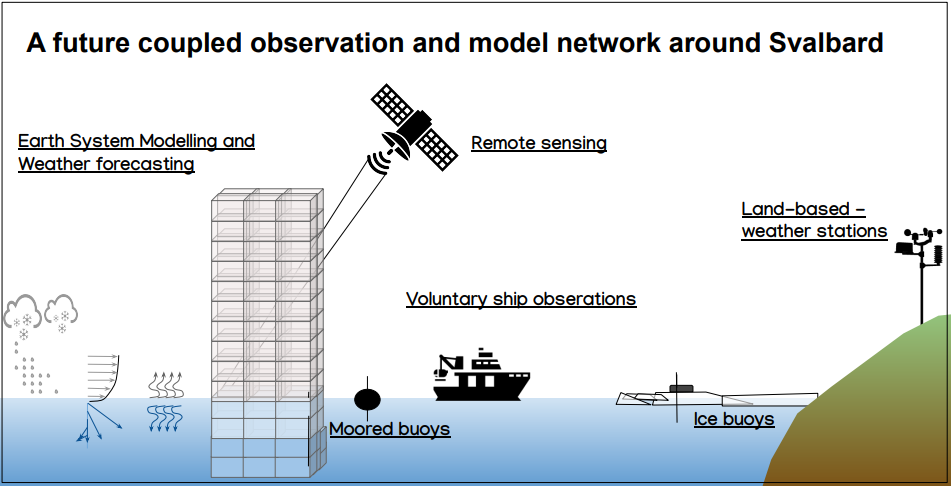
DonSval establishes a coordinated, distributed observation network around Svalbard to strengthen model development and process understanding in the coupled Arctic system. The project focuses on atmosphere-ocean-wave-sea-ice interactions and supports both climate research and operational forecasting through harmonized observations, improved data access, and closer integration with forecasting systems.
The project builds on existing monitoring initiatives and campaign activities and connects them through a shared framework for data synthesis, coordinated intensive observation periods, and model intercomparison. By combining in situ measurements, satellite products, and numerical models, DonSval aims to improve representation of local coupled processes around Svalbard and strengthen pan-Arctic forecast capability.
Core observation network elements
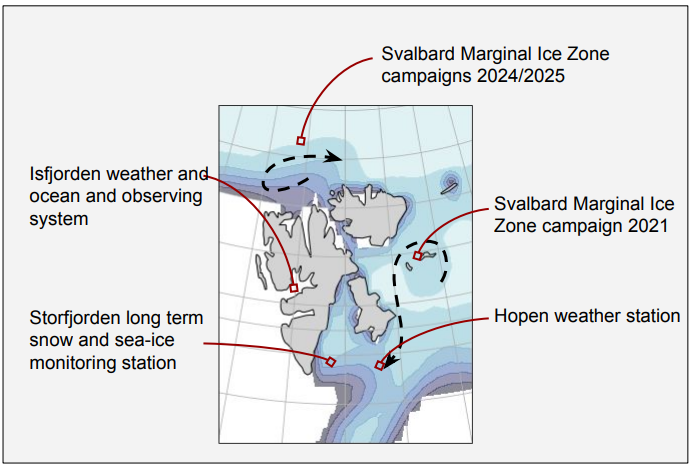
- Isfjorden Weather and Ocean Observing System (IWOOS) for high-resolution atmosphere-ocean measurements.
- Long-term sea-ice monitoring in Storfjorden and additional sea-ice observations in the Svalbard region.
- SvalMIZ campaign observations in the Marginal Ice Zone, including distributed buoy deployments.
- Meteorological station network across Svalbard, with specific focus on sea-ice exposed environments.
- Coupled weather-ocean-ice forecasting systems for coordinated validation and model development.
- Data coordination aligned with SIOS and FAIR data principles.
Implementation focus
DonSval is structured around three connected tasks: observation synthesis, model intercomparison, and intensive observation periods. The project coordinates observational datasets from multiple platforms, develops shared evaluation protocols for forecasting systems, and supports targeted field activities to capture coupled dynamics during high-value periods.
Expected impact
By integrating distributed observation networks with model development, DonSval supports more robust Arctic forecast and climate systems, including improved understanding of atmosphere-ocean-ice coupling, better model benchmarking, and stronger coordination across institutions. This contributes to safer maritime and aviation operations and stronger environmental monitoring in and around Svalbard.
Partners



Updates and related campaign outputs are shared through the Projects page and the Data and papers page.