Overview
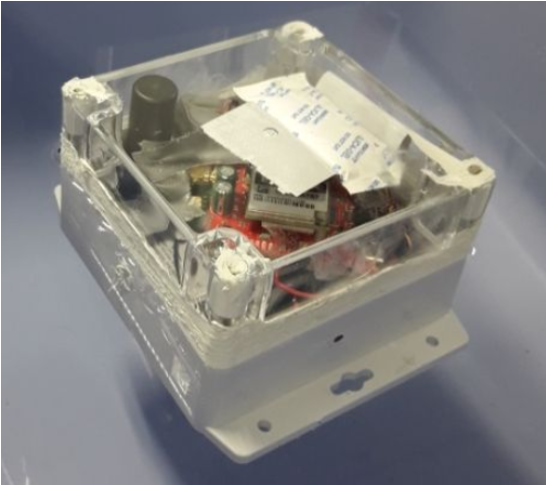
The OpenMetBuoy (OMB) is a low-cost, open source, customizable buoy. The design is described and validated in Rabault et al 2022 , and all the blueprints and codes are available at github-repo.
The key characteristics of the OMB is its low cost: building and operating one OMB for three months in the MIZ typically costs around 1,000 USD. This is around an order of magnitude less expensive than commercially available alternatives with similar performance. The OMB is also small (typically around 1L volume and 850g weight in its standard version) and power efficient, and it can operate for many months using only a few D-cell batteries. Global connectivity is provided by the on-board iridium modem, and a GPS and IMU are also included to measure position and wave motion, respectively. In addition, the OMB can be extended by adding task specific sensors, such as temperature strings, atmospheric temperature and pressure sensors, wind sensors, as we will do in the present deployments.
The OMB has been adopted by several groups thanks to its open source design. OMBs have been deployed in many conditions, ranging from 1 year operation on the stable Antarctic sea ice (Nose et al. 2023) , to freely floating in the Caribbeans and measuring wave and storm activity.
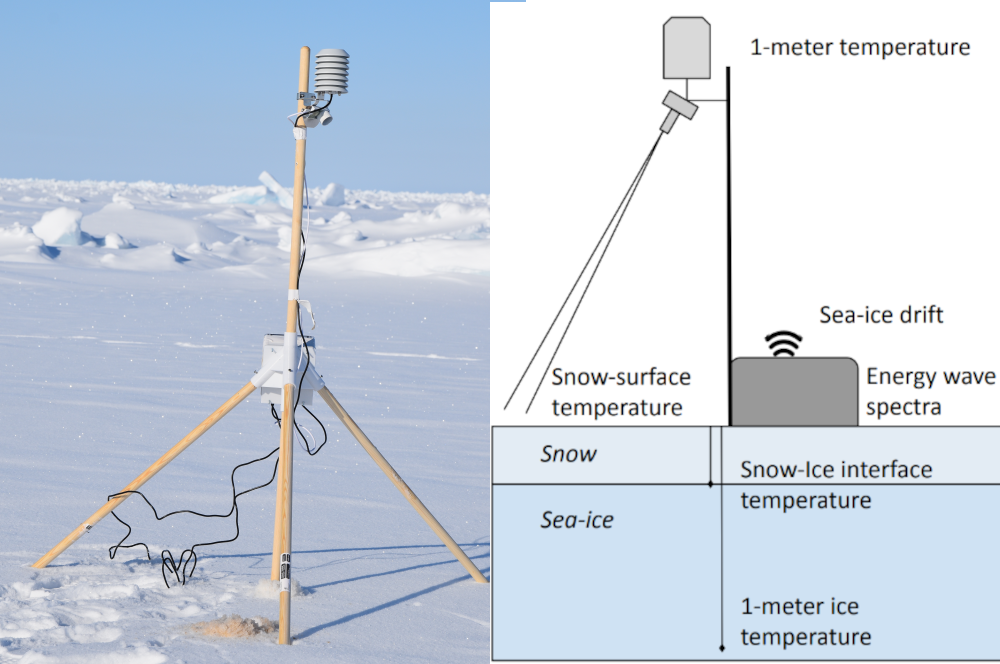
The newest OMB configurations include extended temperature sensing in both the atmosphere and the ice/ocean interface, together with infrared surface temperature sensors. These additions are designed to better resolve coupled air-ice-ocean variability and to support model evaluation in the Marginal Ice Zone and central Arctic.
Recent deployments with these upgraded sensor packages are presented in SvalMIZ-24, SvalMIZ-25, and ArctSum-25. More releases and publications are listed on the Data and papers page.