The IWOOS project
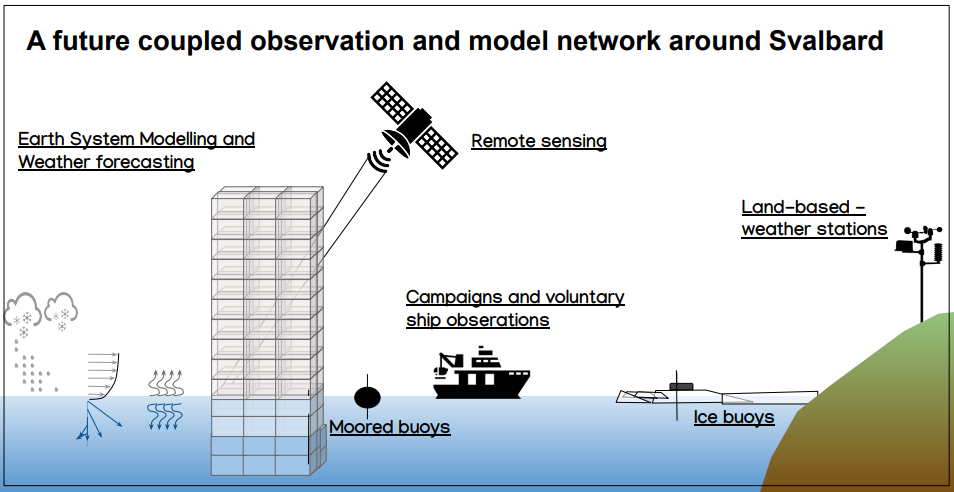 Isfjorden Weather and Ocean Observing System (IWOOS) The Isfjorden Weather and Ocean Observing System (IWOOS) is an integrated, multi-platform observing system established to monitor atmosphere–ocean interactions and climate change impacts in the Isfjorden region of Svalbard. Located in a rapidly warming Arctic hotspot, Isfjorden is strongly affected by Atlantification, declining sea-ice cover, and complex local weather phenomena driven by steep topography and fjord geometry. The main objective of IWOOS is to provide long-term and near-real-time observations of key atmospheric and oceanic variables to support process studies, climate monitoring, operational forecasting, and enhanced safety for human activities in this harsh Arctic environment.
 Ocean moorings and in-situ observations:
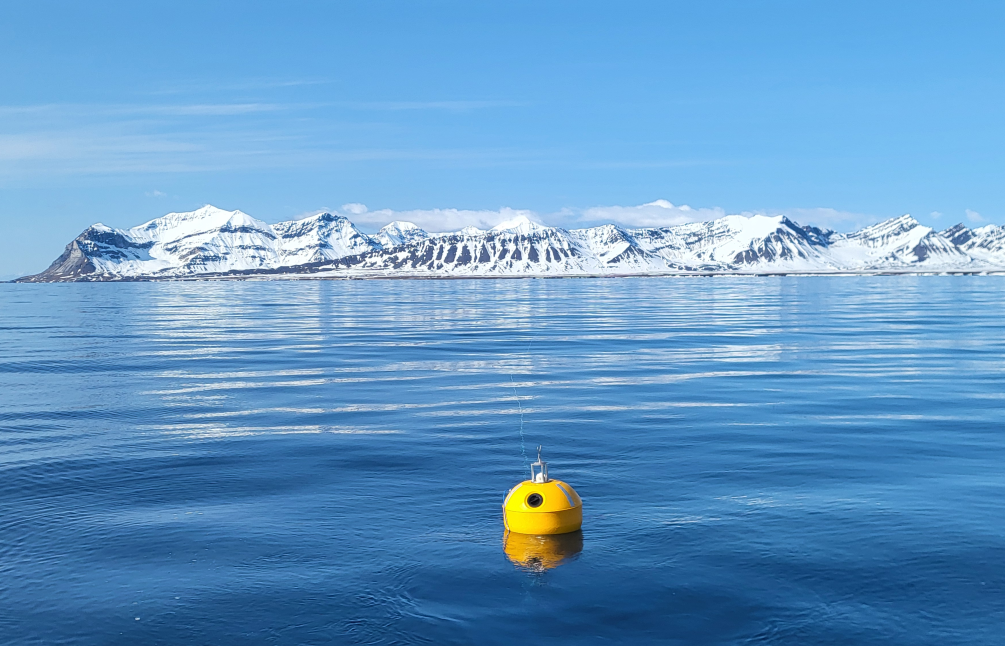
A core component of IWOOS is a network of five autonomous ocean moorings strategically deployed within Isfjorden. These moorings are equipped with sensors measuring surface wave properties and high-resolution temperature profiles in the upper ocean (upper ~10 m), with two moorings additionally instrumented with deeper conductivity–temperature–depth (CTD) sensors. Based on the open-source OpenMetBuoy platform, the moorings transmit near-real-time data via satellite while storing deeper measurements for recovery during annual maintenance. Together with complementary ship-based and lighthouse-mounted observations, the moorings provide continuous in-situ data that capture both short-term variability and long-term environmental change in the fjord system. here.
Ocean moorings and in-situ observations:
A core component of IWOOS is a network of five autonomous ocean moorings strategically deployed within Isfjorden. These moorings are equipped with sensors measuring surface wave properties and high-resolution temperature profiles in the upper ocean (upper ~10 m), with two moorings additionally instrumented with deeper conductivity–temperature–depth (CTD) sensors. Based on the open-source OpenMetBuoy platform, the moorings transmit near-real-time data via satellite while storing deeper measurements for recovery during annual maintenance. Together with complementary ship-based and lighthouse-mounted observations, the moorings provide continuous in-situ data that capture both short-term variability and long-term environmental change in the fjord system. here.
Applications: satellites, models, and cross-comparison: IWOOS data are designed to play a central role in cross-comparison and integration with satellite observations and high-resolution coupled atmosphere–ocean–wave models. The in-situ measurements enable systematic validation of satellite-derived surface temperatures and sea-state products, helping to quantify satellite product uncertainties. At the same time, the observations support evaluation and assimilation in operational and research forecasting systems, improving representation of fine-scale processes in high-resolution coupled models. Through this synergy, IWOOS strengthens the observational foundation needed to advance Arctic Earth-system science, improve predictive skill, and enhance the reliability of environmental information used for decision-making in the region.
More information on related projects and an overview can be found here here. Real-time monitoring can be found here